
Medicinal Plants for Home Gardens: 15 Essential Plants to Grow in India

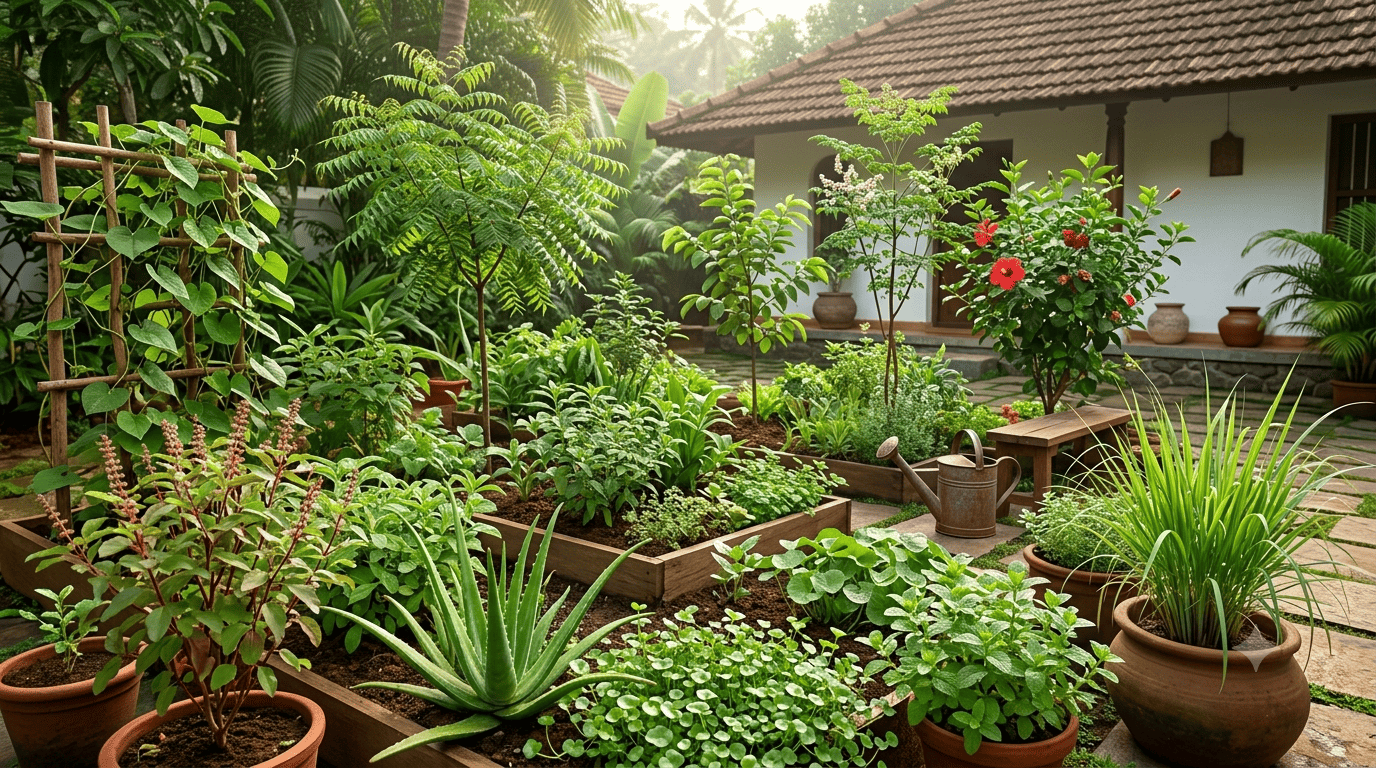
Growing medicinal plants for home gardens is a practical way to bring more greenery into your home while learning about India’s rich botanical and traditional plant heritage. From familiar Tulsi and Aloe vera to Neem, Amla, Brahmi and Ashwagandha, many medicinal and traditionally important plants can be cultivated in suitable home gardens, balconies, terraces and outdoor spaces.
India has a remarkable diversity of medicinal plants. The Ministry of AYUSH’s e-Charak database currently documents thousands of medicinal plant species and provides information such as botanical names, trade names and plant parts associated with different species.
However, growing a medicinal plant is different from using it as medicine. A plant’s traditional use does not automatically mean that consuming it is safe or appropriate for everyone. This article focuses primarily on plant selection, cultivation and garden care, while traditional importance is discussed as botanical and cultural context.
Why Cultivating Medicinal Plants for Home Gardens Matters
A home medicinal garden can be much more than a collection of plants. It can become a place to learn about plant identification, cultivation, traditional knowledge and India’s botanical diversity.
Depending on your available space, you can grow medicinal and herbal plants in:
- Home gardens
- Backyard gardens
- Terrace gardens
- Balcony containers
- Courtyards
- Kitchen gardens
- Larger landscape spaces
The National AYUSH Mission has supported cultivation of numerous medicinal plant species in different parts of India, including Aloe vera, Amla, Ashwagandha, Bael, Brahmi, Mandukaparni, Neem, Shatavari and Tulsi.
The important point is that not every plant is suitable for every garden. Climate, sunlight, soil, water availability, container size and mature plant size all influence whether a particular species will grow successfully.
15 Best Medicinal Plants for Home Gardens in India
1. Tulsi — Ocimum Species
Tulsi is one of the most familiar plants in Indian households and has strong cultural and traditional significance.
It is a relatively compact plant that can be grown in suitable pots, balconies, terraces and garden beds. Its manageable size makes it a practical option for people who want to begin a small collection of medicinal and herbal plants.
The Ministry of AYUSH’s e-Charak database lists Tulsi under Ocimum sanctum.
Tulsi generally performs well when it receives suitable sunlight and is planted in a growing medium that does not remain excessively waterlogged.
Growing tip: Choose a location with adequate sunlight and provide water according to the plant’s growing conditions rather than following a fixed daily schedule.
2. Aloe Vera — Aloe barbadensis
Aloe vera is a popular succulent that can be grown in many Indian home gardens.
Its thick, fleshy leaves allow it to store water, and it generally prefers well-drained growing conditions. Aloe vera is particularly convenient for container gardening because it does not require the same amount of space as a mature medicinal tree.
Government medicinal-plant resources include Aloe vera among species supported for cultivation in India.
Growing tip: Use a well-draining growing medium and avoid keeping the roots continuously wet.
3. Neem — Azadirachta indica
Neem is one of India’s most widely recognized medicinal and culturally important trees.
Unlike compact herbs, Neem can become a substantial tree. Therefore, it is better suited to a backyard, farm, large garden or other outdoor location where it has enough room to develop.
The Ministry of AYUSH’s e-Charak database lists Azadirachta indica as Neem and identifies the leaf among its documented plant parts.
Growing tip: Plant Neem in a sunny outdoor location and consider its eventual size before selecting the planting position.
4. Amla — Phyllanthus emblica
Amla, also known as Indian Gooseberry, is an important Indian fruit-bearing tree with culinary, cultural and traditional significance.
Amla can become a sizeable tree, so it should be considered a long-term garden plant rather than simply a small container plant.
The Ministry of AYUSH’s e-Charak database lists Amla as Emblica officinalis, while current botanical usage commonly uses Phyllanthus emblica.
Growing tip: Choose a sunny outdoor position with good drainage and sufficient space for long-term growth.
5. Brahmi — Bacopa monnieri
Brahmi is a small herbaceous plant associated with traditional Indian plant knowledge.
Its relatively compact growth habit can make it suitable for certain home gardens and containers. Unlike drought-tolerant succulents, Brahmi generally prefers more consistently moist growing conditions.
Brahmi is included in the Ministry of AYUSH’s medicinal plant database and in government-supported medicinal plant cultivation lists.
Growing tip: Maintain appropriate moisture while ensuring that the growing environment does not become unsuitable for the plant’s roots.
6. Ashwagandha — Withania somnifera
Ashwagandha is a well-known medicinal plant associated with Ayurveda and traditional Indian plant knowledge.
It develops as a relatively compact plant compared with larger species such as Neem and Amla, making it an interesting option for gardeners with appropriate outdoor growing conditions.
Withania somnifera is listed in the Ministry of AYUSH’s medicinal plant resources and among species supported for cultivation under the National AYUSH Mission.
Growing tip: Provide suitable sunlight and avoid locations where water remains around the roots for extended periods.
7. Moringa — Moringa oleifera
Moringa, commonly known as the Drumstick Tree, is widely grown in India and is valued for its culinary and traditional importance.
It can develop into a sizeable tree, so gardeners should consider the available space before planting it permanently.
The Ministry of AYUSH’s e-Charak database lists Moringa oleifera and documents both seed and leaf as plant parts.
Growing tip: Provide sufficient sunlight, good drainage and enough room for the plant to grow naturally.
8. Shatavari — Asparagus racemosus
Shatavari is a traditionally important medicinal plant associated with Ayurveda.
It has a distinctive growth habit and can be a useful addition to a diverse medicinal plant collection. Government cultivation records include Shatavari among medicinal plant species supported under the National AYUSH Mission.
Because regional names can vary, gardeners should check the botanical name when purchasing a Shatavari plant.
Growing tip: Provide suitable drainage and enough growing space for the plant’s natural development.
9. Guduchi — Tinospora cordifolia
Guduchi, also commonly known as Giloy, is a climbing plant with a long history of traditional use in India.
Unlike upright garden plants, Guduchi benefits from a suitable support structure that allows its climbing stems to develop.
The Ministry of AYUSH’s e-Charak database lists Tinospora cordifolia under the trade name Gilo and identifies the stem among its documented plant parts.
Growing tip: Provide a sturdy trellis, support or other appropriate structure for climbing growth.
10. Bael — Aegle marmelos
Bael is an important Indian tree with cultural, botanical and traditional significance.
It is better suited to gardens and larger outdoor spaces because of its eventual size. Before planting Bael, consider the amount of space available around the plant and its long-term growth.
- Aegle marmelos* is included in the Ministry of AYUSH’s medicinal plant database and government cultivation records.
Growing tip: Select a sunny outdoor location with suitable drainage and adequate long-term space.
11. Curry Leaf — Murraya koenigii
Curry Leaf is a familiar plant in Indian households, particularly for culinary use, while also having a history of traditional plant use.
It can be grown in suitable containers or directly in garden soil. Regular pruning can help maintain a manageable shape when grown in smaller spaces.
For home gardeners, Curry Leaf can add both practical culinary value and diversity to a garden collection.
Growing tip: Provide adequate sunlight, appropriate watering and good drainage.
12. Mint — Mentha Species
Mint is a familiar aromatic herb that can be grown in many home gardens.
It can spread quickly under favourable conditions, so containers can be useful when gardeners want to control its growth.
Because “Mint” can refer to several species and varieties, checking the botanical identity of the plant is useful when developing a specific botanical collection.
Growing tip: Consider growing Mint in a separate container if you want to limit its spread.
13. Lemongrass — Cymbopogon citratus
Lemongrass is an aromatic grass that can be grown in suitable home gardens and containers.
Its distinctive fragrance and clumping growth habit make it an interesting addition to an herbal or aromatic garden.
The Ministry of AYUSH’s e-Charak database lists Cymbopogon citratus under Lemongrass and identifies the upper part of the plant in its database.
Growing tip: Provide adequate sunlight, appropriate drainage and sufficient room for the plant clump to expand.
14. Hibiscus — Hibiscus rosa-sinensis
Hibiscus is a familiar flowering plant in Indian gardens and has considerable cultural importance.
It can add colour and visual variety to a medicinal or herbal garden while also contributing to a broader plant collection.
The Ministry of AYUSH’s e-Charak database lists Hibiscus rosa sinensis under Gudhal and identifies its flower.
Growing tip: Provide suitable sunlight, well-managed soil moisture and enough space for healthy growth.
15. Mandukaparni — Centella asiatica
Mandukaparni, commonly known as Indian Pennywort, is a small herbaceous plant documented in Indian medicinal plant resources.
Its smaller growth habit makes it an interesting option for gardeners who want to develop a diverse collection without relying entirely on large trees and shrubs.
The Ministry of AYUSH’s e-Charak database lists Centella asiatica as Mandukparni and identifies the whole plant.
Growing tip: Provide suitable moisture and drainage based on the plant’s growing environment.
How to Select Medicinal Plants for Home Gardens
Choosing medicinal plants for home gardens should start with your growing environment rather than simply selecting the most popular species.
Consider these factors before purchasing a plant.
1. Available Space
Measure the area where you intend to grow the plant.
A balcony may be suitable for compact plants such as Tulsi or Aloe vera, while Neem, Amla and Bael require considerably more space as they mature.
2. Sunlight
Observe how much direct sunlight your garden receives during the day.
Different plants have different light requirements, so check the care requirements of the individual species before deciding where to place it.
3. Local Climate
India has highly varied climatic conditions.
Temperature, rainfall, humidity and seasonal changes can influence plant growth. A species that performs well in one region may require different care in another.
4. Water Requirements
Consider how much water you can provide and how quickly your soil or containers drain.
Avoid applying the same watering schedule to every plant.
5. Mature Plant Size
A small nursery plant may eventually become a large tree.
This is especially important for Neem, Amla, Bael and Moringa.
Always consider the mature size before planting a species close to buildings, walls, pathways or other permanent structures.
Growing Medicinal Plants for Home Gardens in Pots
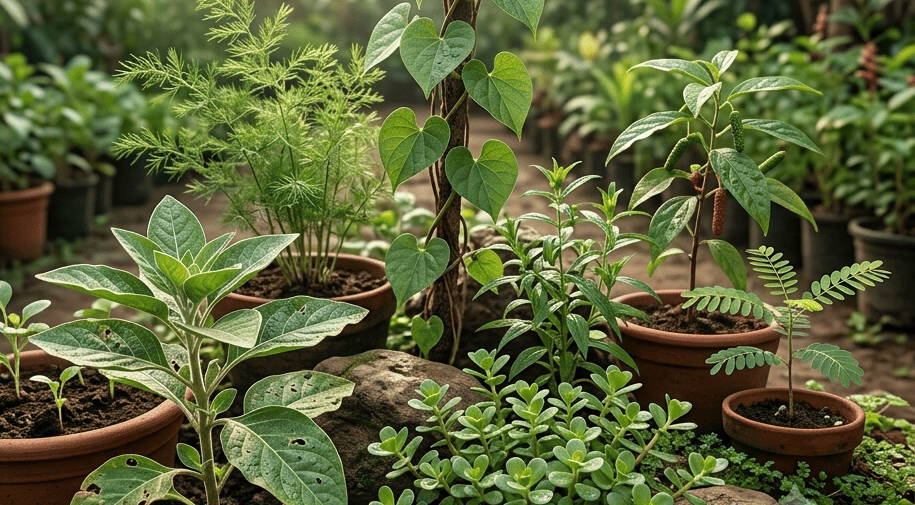
Yes. Many medicinal and herbal plants can be grown successfully in containers when their individual requirements are met.
Container gardening is particularly useful for:
- Tulsi
- Aloe vera
- Brahmi
- Mint
- Lemongrass
- Smaller herbal plants
- Selected young medicinal plants
The container should provide adequate root space and drainage.
As the plant grows, it may eventually need a larger container or a permanent location in the ground.
Large trees can be started as young plants in containers, but their long-term size should always be considered before purchase.
Best Potting Soil for Medicinal Plants for Home Gardens
There is no single soil mixture that is ideal for every medicinal plant.
Different species have different requirements for moisture, drainage, organic matter and root space.
For many home gardens, good drainage is an important consideration. Soil that remains continuously waterlogged can create unsuitable growing conditions for plants that prefer better drainage.
Before planting, consider:
- Soil drainage
- Moisture requirements
- Root space
- Organic matter
- Container size
- Local climate
- Plant species
The goal is to match the growing medium to the individual plant rather than using one formula for every species.
Watering Guidelines for Medicinal Plants for Home Gardens
There is no universal watering schedule for medicinal plants for home gardens.
Water requirements can change according to:
- Plant species
- Pot size
- Soil type
- Temperature
- Rainfall
- Humidity
- Sunlight
- Plant maturity
A succulent such as Aloe vera generally requires a different watering approach from a plant that prefers more consistent moisture.
Check the growing medium and the specific plant’s requirements instead of watering every plant on a fixed schedule.
Cultivating Medicinal Plants for Home Gardens Across India
Many medicinal plant species can be cultivated in different regions of India, but suitability varies by species and local conditions.
India includes a wide range of climatic environments, including tropical, subtropical, dry, humid, coastal, plateau and mountainous regions.
When selecting a plant, consider:
- Temperature
- Rainfall
- Humidity
- Sunlight
- Soil
- Seasonal conditions
Government cultivation records demonstrate that numerous medicinal species have been supported across different Indian states under the National AYUSH Mission.
For home gardeners, however, the important question is whether the specific plant matches the conditions available in your garden.
Why Botanical Names Matter When Ordering Medicinal Plants Online
Common plant names can vary between regions and languages.
The same plant may be known by different local names, while similar names can sometimes refer to different species.
For example:
- Tulsi — Ocimum species
- Neem — Azadirachta indica
- Amla — Phyllanthus emblica
- Ashwagandha — Withania somnifera
- Brahmi — Bacopa monnieri
- Shatavari — Asparagus racemosus
- Guduchi — Tinospora cordifolia
- Mandukaparni — Centella asiatica
The Ministry of AYUSH’s e-Charak database provides botanical and trade-name information for medicinal plants.
When buying plants online, checking the botanical name can therefore help you research the correct species and its cultivation requirements.
Quality Checklist Before Buying Live Plants Online
Before ordering a live plant, look beyond the product name.
A useful product listing should ideally provide information such as:
- Botanical name
- Common name
- Plant size
- Plant availability
- Sunlight requirements
- Watering requirements
- Growing conditions
- Suitable climate
- Shipping information
- Packaging information
- Return or replacement information where applicable
This information helps gardeners choose plants that are appropriate for their available space and growing conditions.
For beginners, choosing a plant that matches the garden environment is generally more practical than choosing one based only on its traditional reputation.
Step-by-Step Guide: Starting Your Home Medicinal Garden
You don’t need a large property to start growing medicinal plants for home gardens.
A beginner can start with a few suitable species and gradually expand the collection.
Step 1: Assess Your Space
Determine whether you have a balcony, terrace, backyard, courtyard or larger garden.
Step 2: Check Sunlight
Observe how much direct sunlight your location receives throughout the day.
Step 3: Understand Your Climate
Consider the typical temperature, rainfall and humidity in your area.
Step 4: Start With Manageable Plants
Compact plants can be easier for beginners than large trees.
Step 5: Select Suitable Containers
Choose containers with enough space for root development and adequate drainage.
Step 6: Learn Individual Plant Care
Don’t assume that all medicinal plants require the same amount of sunlight, water or soil moisture.
Step 7: Monitor Plant Growth
Observe the plant regularly and look for changes in leaves, soil moisture and overall growth.
Step 8: Expand Gradually
Once you understand how your first plants respond to your local conditions, introduce additional species.
Medicinal Plants for Balconies, Terraces & Backyard Gardens
Medicinal Plants for Balcony Gardens
Balcony gardeners can consider compact species such as:
- Tulsi
- Aloe vera
- Brahmi
- Mint
Container size, drainage and sunlight are particularly important in balcony gardening.
Also consider the weight of large containers before placing them on a balcony or elevated structure.
Medicinal Plants for Terrace Gardens
Terraces can accommodate a broader collection of medicinal and herbal plants when suitable containers, drainage and growing conditions are available.
A terrace garden can combine compact herbs, aromatic plants and selected larger plants in appropriately sized containers.
Medicinal Plants for Backyard Gardens
A backyard generally provides greater flexibility for plants that eventually become shrubs or trees.
Neem, Amla, Bael and Moringa can be considered when sufficient long-term space is available.
Before planting larger species, consider their mature size and distance from buildings and other permanent structures.
Building a Diverse Herbal Garden Collection
A home collection does not need to contain dozens of species from the beginning.
Start with a manageable group of plants and learn how each one responds to your local environment.
You can gradually introduce different growth habits:
Compact herbs: Tulsi, Brahmi and Mint
Succulents: Aloe vera
Climbing plants: Guduchi
Smaller shrubs: Ashwagandha
Larger plants and trees: Neem, Amla, Bael and Moringa
This approach allows you to build a diverse collection while learning the different cultivation requirements of individual plant species.
Safety Guidelines for Home-Grown Medicinal Plants
A plant being described as medicinal does not automatically mean that it is safe for everyone to consume.
Safety can depend on factors such as:
- Correct plant identification
- Plant part being used
- Preparation method
- Quantity
- Individual health conditions
- Existing medicines
- Allergies and sensitivities
Correct identification is particularly important because different plants can have similar common names.
This article is a gardening and botanical information guide, not medical advice. Do not replace prescribed medical treatment with a home-grown plant or herbal preparation.
If you are considering consuming a plant or using it for a particular health condition, consult an appropriately qualified healthcare professional.
Related Botanical Guides & Sourcing:
- Learn step-by-step potting and care in our guide on how to grow medicinal plants at home in India.
- Explore our in-depth profile on rare medicinal plants of India.
- Order authentic native botanicals directly from the Medicinal Live plant nursery.
For verified conservation data and botanical research, visit the National Medicinal Plants Board (NMPB) and medical research repositories on NCBI PubMed.
Frequently Asked Questions: Medicinal Plants for Home Gardens
What are the best medicinal plants to grow at home in India?
There is no single best plant for every home. Tulsi, Aloe vera, Brahmi and Mint can be considered for smaller spaces, while Neem, Amla, Bael and Moringa require substantially more room. The appropriate choice depends on your climate, sunlight, available space and ability to provide suitable care.
Which medicinal plants are suitable for a small balcony garden?
Compact plants such as Tulsi, Aloe vera, Brahmi and Mint can be considered for balcony gardens when grown in suitable containers. Check the plant’s sunlight, watering, drainage and mature-size requirements before purchasing.
Growing Medicinal Plants for Home Gardens in Pots
Yes. Many medicinal and herbal plants can be grown in containers. Pot size, drainage, growing medium, sunlight and watering requirements vary between species, so each plant should be managed according to its individual needs.
Which medicinal plants are suitable for Indian home gardens?
Tulsi, Aloe vera, Brahmi, Ashwagandha and Mint can be considered for smaller home gardens, while Neem, Amla, Bael and Moringa are more appropriate for larger outdoor spaces because of their eventual size.
Which medicinal plants are suitable for beginners?
Tulsi and Aloe vera can be practical starting points for many beginners because they can be grown in suitable containers and generally require less space than large medicinal trees. Growing success still depends on local conditions and appropriate care.
Can medicinal plants be grown throughout India?
Many medicinal plants can be cultivated in different parts of India, but suitability varies by species. Temperature, rainfall, humidity, sunlight and soil conditions all influence plant growth. Choose species that match the conditions in your region.
Where can I buy medicinal plants online in India?
MedicinalLive offers medicinal, herbal, rare, native and aromatic live plants online, along with other plant categories. Customers can explore individual plant listings and check the available plant information, pricing and delivery details before ordering.
How do I choose medicinal plants for my garden?
Start by checking your available space, sunlight, local climate and watering conditions. Then select species whose growing requirements match your environment. For larger species such as Neem, Amla and Bael, also consider their mature size and long-term space requirements.
Conclusion: Start Your Home Herbal Garden
Growing medicinal plants for home gardens is an opportunity to create a greener space while exploring India’s diverse botanical heritage.
The most important step is not simply choosing a plant because it is called medicinal. Learn about the species, check its botanical identity, understand its growing requirements and select a location where it can grow successfully.
For balconies and smaller gardens, compact plants such as Tulsi, Aloe vera, Brahmi and Mint can be considered. Larger gardens can provide space for Neem, Amla, Bael and Moringa.
Whether you are creating a balcony collection, terrace garden, backyard garden or larger botanical space, selecting plants according to your local climate, available space, sunlight and growing conditions gives your garden a stronger foundation for long-term growth.
Explore MedicinalLive’s collection of medicinal, herbal, rare, native and aromatic live plants to discover plants suitable for your home garden and botanical collection.
contact
https://medicinallive.com/popular-medicinal-plants/?utm_source=chatgpt.com